Manual Improvement
This type of agent system has no autonomous improvement capability; it is deployed and executed in a fixed form, and every change requires a manual development and deployment process.
A survey for self-improving agent systems that convert experience, evaluation feedback, and training signals into persistent updates to their own components.
L1–L5 grades the self-improvement capability of related work
The key distinction is not whether the agent can suggest an improvement, but whether it can propose, apply, validate, and eventually revise the improvement mechanism itself.
| Level | Category Name | Autonomous Proposal | Autonomous Implementation | Autonomous Validation | Improve the Improvement Mechanism | Domain Generality |
|---|---|---|---|---|---|---|
| L1 | Manual Improvement | |||||
| L2 | Assisted Improvement | ✓ | ||||
| L3 | Programmatic Self-Improvement | ✓ | ✓ | ✓ | ||
| L4 | Bounded Recursive Self-Improvement | ✓ | ✓ | ✓ | ✓ | |
| L5 | General Recursive Self-Improvement | ✓ | ✓ | ✓ | ✓ | ✓ |
This type of agent system has no autonomous improvement capability; it is deployed and executed in a fixed form, and every change requires a manual development and deployment process.
This type of system can propose candidate modifications or diagnostic evidence, but humans remain responsible for validating and applying substantive changes while the improvement mechanism remains human-maintained.
This type of system can autonomously propose, apply, and validate modifications to operational components such as the foundation model, agent harness, data system, or trainer, while the improvement mechanism remains fixed or externally maintained.
This type of system can propose, validate, and apply candidate modifications while also rewriting its own improvement mechanism, making the improvement process self-referential within a bounded domain.
L5 retains the autonomy, self-reference, and long-term progress of L4 while transferring improvement capability across broad and evolving task domains rather than remaining limited to a fixed benchmark or narrow operational setting.
Filter representative papers across multiple dimensions
| Paper | Component | Year | Level | Focus |
|---|---|---|---|---|
| Loading papers from papers.yaml… | ||||
A map of what today’s systems are improving
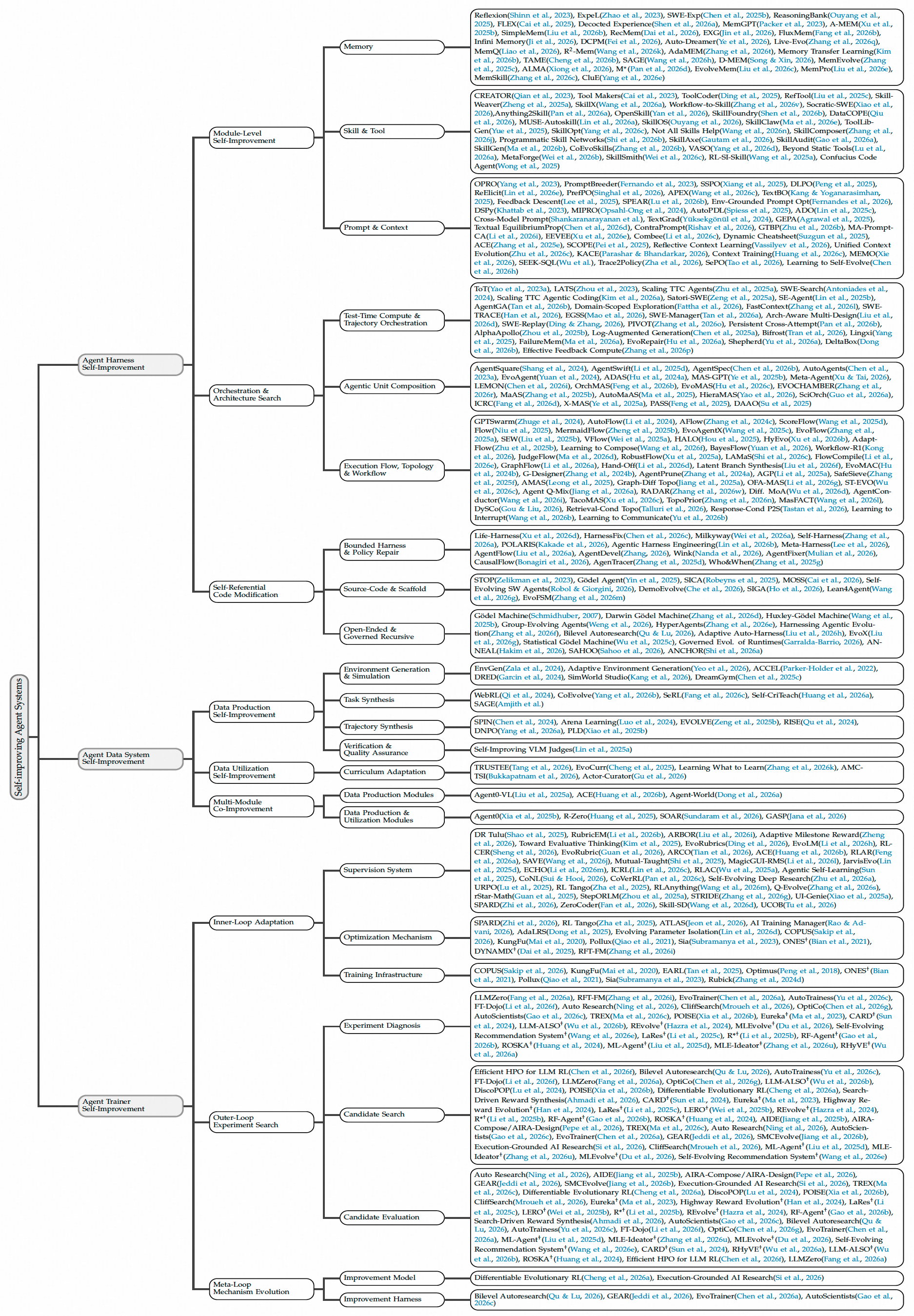
Persistently revises the non-parametric execution layer—memory, skills, tools, prompts, workflows, orchestration, and scaffold code—that controls what agents observe, invoke, and organize into goal-directed workflows
Iteratively improves data production and utilization, including environment generation, task and trajectory synthesis, verification, and curriculum adaptation, to generate higher-quality training and evaluation data from verification and training feedback
Uses training and evaluation evidence to persistently revise how data become model updates, including supervision design, optimization strategy, training infrastructure, and the trainer-improvement mechanism
Examines system-level feedback loops where harness, data, and trainer components jointly improve through dependency relationships as bottlenecks shift across the evolving agent system
Open problems on the path to general and reliable RSI agent
Benchmarks should test whether repeated self-modification improves reliability, robustness, usefulness, capability retention, and the improvement process itself under evolving workloads, goals, budgets, tools, and environments
RSI needs unified, agent-friendly representations of execution traces, training records, validation results, version histories, and resource usage so agents can observe, reproduce, compare, and safely revise the improvement process
The key challenge is to make improvement mechanisms transferable across domains while avoiding the inappropriate transfer of task-specific strategies that fail in new settings
Systems must keep capability-oriented components modifiable while protecting governance components through stricter verification, continuous monitoring, rollback versions, safety alerts, incident logs, and human review
High-impact applications need agents that know when to involve experts, choose the right interaction form, provide interpretable evidence, and convert expert feedback into reusable improvement resources
Cite this survey and contribute to this repository
@article{202608.0051,
  doi = {10.20944/preprints202608.0051.v1},
  url = {https://www.preprints.org/manuscript/202608.0051},
  year = 2026,
  month = {August},
  publisher = {Preprints},
  author = {Shuaiqi Liu and Zhengkai Lin and Yuxiang Zhang and Yuanyi Ren and Yue Wu and Yongbin Li and Zheng Wang and Zhihang Fu and Jieping Ye},
  title = {The Path to Recursive Self-Improving Agents: Foundation, Framework, and Future Directions},
  journal = {Preprints}
}